
I’ve been learning Japanese for twenty years, but it hasn’t been consistent. I’ve stopped and started, bounced around multiple different study methods, and overall had a very slapdash approach to the language. But even then I’m shocked at how bad Duolingo is at teaching Japanese.
I see people with 1000 day streaks unable to construct sentences. Who struggle to remember even basic words and grammar. Who can’t understand Japanese outside of the context of the app.
It’s very frustrating to see because you know Duolingo makes a lot of money, but their courses are very slap-dash and not designed to teach Japanese effectively. Let me explain why apps like this don’t work.
How Does Duolingo “Teach”?
The First Successful Language App
First, we need to flashback about 30 years ago when Rosetta Stone was the program for learning languages.
Rosetta Stone’s teaching method was based on immersive learning. This was from the founder’s own experience learning German naturally while living there. He tried to learn Russian through classes but didn’t find it as intuitive or enjoyable, so make Rosetta Stone to try and re-create that immersive learning experience.
Rosetta Stone’s immersive learning approach teaches vocabulary and sentences through pictures and audio. There are no translations or explanations of grammar points because users are supposed to learn how the language works from context.
Every single language has the exact same format. The same words, the same order, the same example sentences. The idea being that every language uses the same basic words in the same way. (Slight spoiler, they don’t.)
This was a very successful format for out-of-classroom language learning (and making money) so modern language applications adopted the same approach. Including Duolingo.
Words and Sentences Through Translation
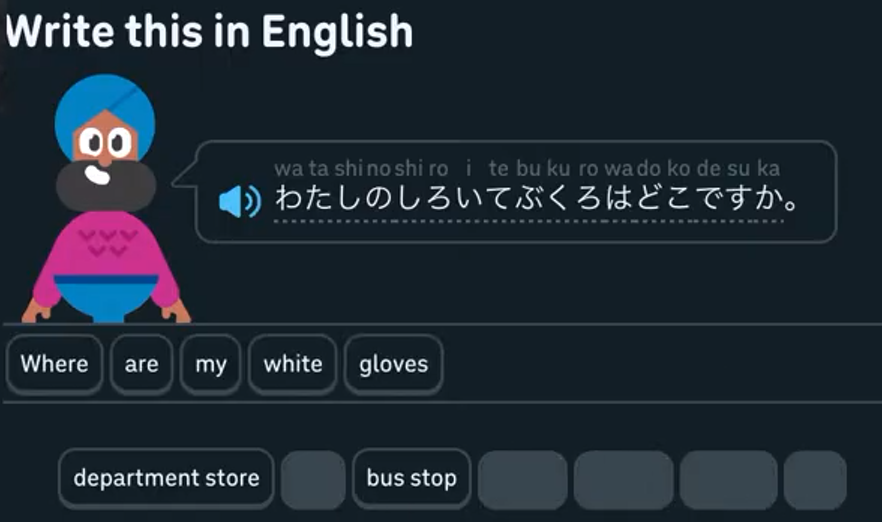
Just like Rosetta Stone the Duolingo courses teach you a few words then introduce those words in the context of sentences. However, it doesn’t do this through pictures, but translations.
So instead of seeing a picture of a cat and the word ねこ, you see “cat” and ねこ (or actually 猫, but we’ll come back to that.) The words are then supposed to be solidified through exercises such as word connection, or moving words missing in a sentence, or re-ordering the words to make a complete sentence.
The implication is that you should start to learn the grammar and vocabulary through these example sentences.
Bite-Sized Sessions
Duolingo’s language courses are also broken down into short easy to do 5-10 minute sessions.
They’re designed to make it easy for users to complete a quick session in the middle of their busy lives.
Gamification
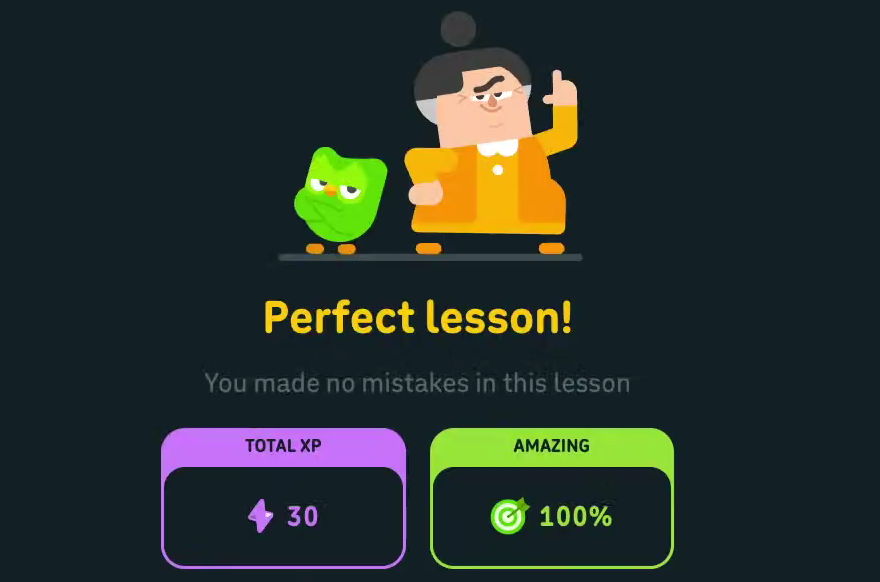
Another large difference from Rosetta Stone is Duolingo’s aggressive gamification to keep its users hooked.
Duolingo doesn’t just teach its users vocabulary and sentences, but does so through gaining experience points, leagues, leaderboards, badges, achievements, streaks, and sparkly UI and sounds when users “achieve” something.
This is supposed to encourage users to return to the app daily to gain more experience, make their daily streak even higher, and “win” language learning.
Why These Tactics Don’t Work for Japanese
A Basic Duolingo Lesson
So a basic lesson on Duolingo will show you some vocabulary with translations. You then “learn” those words through matching the word to the translation or selecting the word you hear.
It then shows you simple sentences which you reorganize into a correct sentence by selecting from a short list of words.
Exercises build on top of one another so you’re listening to and making more complex sentences and learning more vocabulary.
But here’s why this is not effective for Japanese (and potentially other languages.)
Word Association Games Only Train Passive Memory
You have two kinds of memory, passive and active. Passive is when you can’t remember something until you see something to trigger that memory, and active is when you can remember it without any trigger.
When you learn just by word association you don’t train your active memory at all. Only your passive memory.
This makes it incredibly difficult to then use that language in the real world. Fluency is when you’re able to use a language without prompts, without thinking about it.
To train your active memory you should be given a prompt like “cat” and then try to recall the word ねこ by either saying or writing it, not selecting it.
But Duolingo’s method of word association gives you a few options for the word. It gives you the prompt ねこ then gives you a list “cat” “dog” “rabbit”, etc.
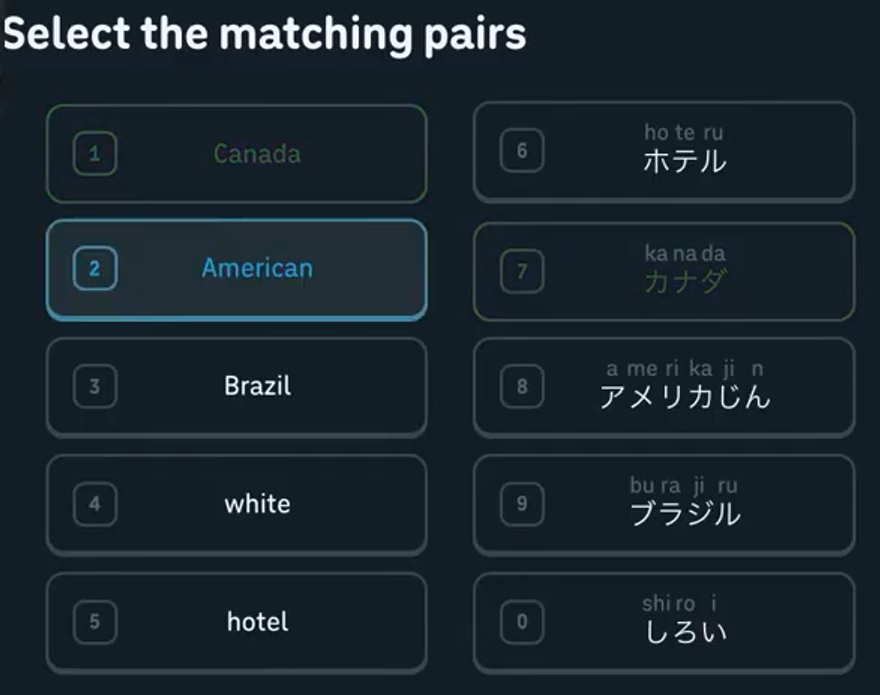
Brains love to be lazy. They’re always trying to find the path of least resistance. These kind of word association games make it easier to “pass” the exercise without actually learning the word.
Even the “speaking” exercises just has users repeat sentences instead of trying to use their active memory to say something without looking it up.
I will say, Duolingo does have some typing exercises where they give you a sentence in English and ask you to type the Japanese. But these aren’t as frequent or strict enough to begin to train your active memory efficiently.
No Way to Memorize Vocabulary
Your brain loves to clear out (what it thinks is) unnecessary information. It will sort through all the things you’ve done in a day and delete information while you sleep. This doesn’t mean the information is completely gone (see passive memory) but the longer you go without reviewing something, the easier it is for your brain to completely forget.
This is called the forgetting curve.

Which means, the best way to memorize vocabulary is to study it then review it at regular intervals, increasing or decreasing the span between those intervals depending on how well you know the word.
The most popular tool for this is called spaced repetition software (SRS). Which Duolingo doesn’t have.
Vocabulary you previously learn will appear in sentences as you progress, but there’s no way to test if you remembered/forgot a word. And because of how the questions are presented it’s easy to remember the words through passive memory, guess the meaning of words you forgot, or brute force the new quiz without worrying about the word you don’t quite remember.
Apps like Duolingo teach its users vocabulary and then barely has them review them. But users don’t notice because the program prompts them with words they’ve studied, triggering their passive memory and making them feel like they’ve learned the word.
No Grammar Explanations
Duolingo’s method of teaching through “immersion”, taken from Rosetta Stone, means that users are supposed to intuit the grammar through context.
In other words, there are no grammar explanations, you’re just supposed to magically understand grammar from example sentences and exercises.
This method might work for European languages which have similar approaches to grammar as English, but Japanese is completely different.
First of all, the sentence structure is completely the opposite. But more than that, formality and other grammar is tied to your relationship with the person you’re talking to. Japanese also uses grammar functions (such as passive, causative, and causative passive sentences) which aren’t common in English or intuitive to English speaking users.
There are a lot of very specific grammar rules which are difficult to understand without explanation. Such as the three grammar groups, how particles work, the different types of adjectives, how translative and intransitive verbs are used, etc.
Duolingo users have commented that grammar at the beginning it intuitive, but becomes impossible as you start to learn more upper-beginner/intermediate levels.
Throws Random Kanji At You
You’re probably aware that Japanese has three writing systems, hiragana and katakana (which Duolingo does teach you), and kanji (which it does not.)
The trick with kanji is each kanji will have several readings depending on what words they’re used in. Japanese words will tend to use kun-yomi (“Japanese readings”) and kanji compounds tend to use on-yomi (“Chinese readings”).
Duolingo doesn’t teach you any of this, it just throws kanji for words at you. It’s also not consistent about when the kanji for a word is provided.
The problem with this is the user is expected to remember not just the word (such as ねこ / “neko” for “cat”) but also the kanji (猫). This results in user learning 猫 means “cat” but not necessarily knowing how to read it or say the word.
Another issue with this is that Japanese words and kanji do not have the same difficulty. “Cat” might be a beginner level word, but the kanji for it is intermediate level. It’s easier to learn the kanji for “cat” later once you’re familiar with other basic kanji that make up the more advanced kanji (these are called radicles.)
The lack of writing exercises for kanji also makes learning them more difficult. Through writing you can more easily learn how to distinguish between similar kanji such as 食 and 飲.
There’s no clear progression when it comes to teaching kanji, the radicles, and different readings to users. This mixed with the inconsistent use of advanced kanji for beginner words makes studying vocabulary more difficult, unless the user is already familiar with kanji and studying it elsewhere.
Doesn’t Teach You Real Japanese
The problem with language learning apps that try to teach every language under the sun, is the courses are often not designed for each language. You learn the same basic vocabulary and same basic sentence structures directly translated from English.
You might think this is fine for early levels where you have to learn “where is the train station?”, but it can also teach you clunky, unnatural Japanese.
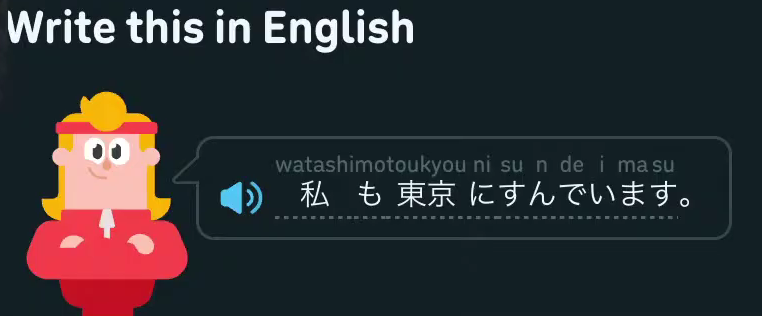
The biggest is the use of “I”. In Japanese “I” is “watashi” (which Duolingo almost instantly teaches with the kanji 私), however, “watashi” is almost never used in Japanese. If you’re talking to someone and a topic has been established, such as “where do you come from?”, you don’t need to say “I am from…”, you just say “from…”.
There’s also the issue of Duolingo teaching weird sentences and vocabulary. This is supposed to help you “remember” the weird stuff, but there’s not much point if you can’t use it.
Gamification Over Learning
Gamification is a great tool for building habits and encouraging you to do something you might not normally enjoy. But apps like Duolingo take it to an unhealthy level.
The reason gamification works so well is because the feeling of achievement triggers dopamine in the brain, which makes you want to keep doing the thing that released the happy-brain juice.
There’s nothing wrong with this per-se, but Duolingo’s graphics, sound design, experience points system, ranking, streaks, etc., put more emphasis on “winning” than “learning.”
A huge part of learning is making mistakes. But Duolingo punishes you if you make any mistakes, and encourages users to rush through courses. This is counterintuitive to actually learning a language, which takes time and trial and error.
The game also shames you, sending sad or threatening messages if you lose your streak or haven’t logged on in a few days. Essentially trying to guilt-trip users into playing more. (Which I personally find incredibly unpleasant and demotivating.)
Duolingo makes it incredibly easy for people to get through their courses because they don’t want users to feel like they’re struggling. If the players are struggling, then they won’t want to give Duolingo money. The game makes them feel like they’re learning without actually helping them learn.
A Money Making Game Company Not a Language Learning App
Although not part of the language “teaching”, I think it’s worth pointing out that Duolingo is a game company concerned about making profit, not teaching languages.
Their aggressive advertising tactics make people think they’re the “only” option for learning a new language. Duolingo has put a lot of money into advertising. You cannot go on any app on the Google or Apple stores without seeing the green owl at least a few times a week.
They regularly pull wacky “stunts” and encourage their users to share streak updates and screenshots of weird sentences.
But it’s “free” right? All you have to do is pay in annoying adverts. But then you’re limited on how many lessons you can take and how many times you can get questions wrong (punishing you for learning by making mistakes.) Or you could give them money to make all that go away and make finishing each level super easy.
The whole app is designed to subtly (or not so subtly) give them money to make language learning more convenient.
All the while cutting costs on their end by firing course creators and translators to use generative AI. Generative AI is a random word generator that doesn’t understand how people learn and is not effective at teaching languages, and reduces the quality of the content that’s already there.
Apps like Duolingo are Games, Not Language Learning Programs
Duolingo, Memrise, LingoDeer, are apps that all use very similar models because they’ve seen it’s an easy way to get money without putting much effort into actually teaching you languages.
They all focus more on triggering user’s dopamine and making them think they’re learning, when they’re not.
The vast majority of people I’ve seen who share their 300, 600, 1000 day steaks seem to always say “I can’t use it” or “I still suck”. If you’ve been studying Japanese for a year or two, you should already be able to form basic sentences and have a strong foundation in the language.
That’s not to say some people have found Duolingo helpful to their Japanese learning. You can find a number of people on Reddit talking about how they used it to study. However, it’s important to know that ALL the people on reddit who found success using Duolingo ALSO used other tools to study the language. Such as SRS app Anki, kanji study textbook Memorizing the Kanji, and grammar explanations through Tae Kim’s Guide to grammar and videos on YouTube.
Basically, the vast majority of people who used Duolingo to learn Japanese say it only works if you use other things to study the language with. In which case…what does Duolingo offer that other resources don’t? Besides triggering the happy brain juices and making you think you’re learning.
When you look at Duolingo as a language learning app it’s clear you can’t use it to learn Japanese to any level of fluency. It is not a language learning program, it’s a game.
What Does Work?
Textbooks, apps designed specifically for Japanese, podcasts and YouTube, workbooks, teachers, etc. A wide variety of tools and resources and study methods that train your reading, writing, speaking, and listening skills. Things that train your active memory so you can use the language without thinking about it.
If you’re a beginner looking to study Japanese here’s a list of books and apps and suggestions on how you can study different parts of the language: How to Learn Japanese
If you’re an intermediate learner, here’s a list of resources for you: Boosting Your Japanese
Other Articles You Might Find Useful
What 20 Years of Learning Japanese Has Taught Me
Passive and Active Memory – Turn Passive Learning into Active Use!
A Simple Trick to Improve Speaking Japanese as a Beginner